
Frequently Asked Questions
Question: Can a depot refuse to accept containers?
Answer: If there is liquid or other debris in the container, then depots can refuse to take containers. Always ensure your containers are empty before taking to depot.
Question: Do I need to remove the plastic ring on the neck of the bottle as well?
Answer: No you don’t. The rings have no adverse effect on the recycling of the container, however you do need to remove the lids.
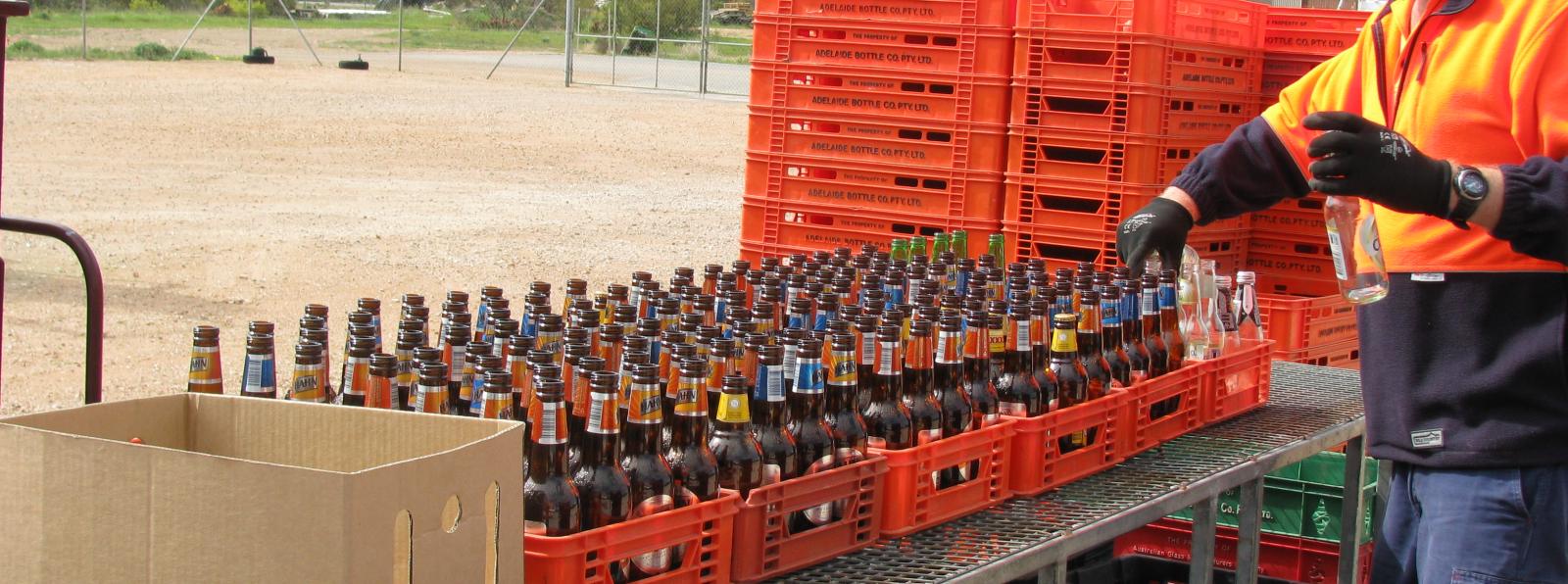
Question: Do I have to sort my containers prior to bringing them to the depot?
Answer: No you don’t. However, if you do have them sorted, it will be a quicker process.
Question: Can we crush our cans?
Answer: We would prefer you don't crush cans as it is difficult to identify the brand and see deposit marking. Also when cans are crushed they can have sharp edges which can cause handling risks.
Question: Do we need to remove the labels from bottles?
Answer: No you don't. Labels are fine, just no lids or liquid!
Question: What are plastic drink bottles made from?
Answer: Plastic drink bottles sold in South Australia are primarily made using three types of plastic;
- polyethylene terephthalate (PET or PETE for short) - is clear and is commonly used to make soft drink and water bottles.
- high density polyethylene (HDPE for short) - is opaque, with a waxy surface (and can also be coloured) and is common for juice or milk bottles.
- polyvinyl chloride (PVC) - is strong and clear and is often what juice bottles are made from.
Question: What is the melting point of plastic bottles?
Answer: This depends on what type of plastic it is. PET plastic melts at 80°C, HDPE melts at 75°C and PVC melts at 80°C.
Question: What do they recycle plastic bottles into?
Answer: They are recycled into other plastic items, including pillow and sleeping bag filling, carpet, building insulation,fleece jackets, plastic buckets, fencing, pipes and of course, more plastic bottles!
Did you know it takes 25 two litre plastic bottles to make a large sized fleece jacket!
Question: What happens to glass bottles when they are recycled?
Answer: Generally, the glass bottles that are recycled in SA have contained alcoholic beverages and will be one of three colours; clear, brown and green. These different coloured glass bottles are separated for recycling. Glass will be turned into new glass bottles or fibreglass insulation, water filtration medium or event abrasives such as sandpaper.
It is vitally important that there are no contaminants when you are recycling glass, as even the smallest amount can result in the glass being rejected from the glass recycling process and sent to landfill.
A large amount of energy is required to produce glass bottles due to the high temperature of 1500°C required to melt it. There is also a cost on the environment by using raw materials that can not be replaced, such as sand, bauxite and iron ore. Recycling glass bottles therefore not only saves energy and greenhouse gas emissions it reduces the amount we take from our planet.
Did you know that Glass can be recycled an infinite number of times without any loss of quality!